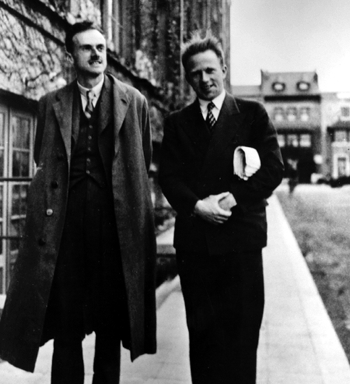
Werner and Paul Adrien Maurice on a Steamer

Is this the interaction picture?

W. Heisenberg and P.A.M. Dirac, two of the founders quantum mechanics, were on a steamer boat from America to Japan. Heisenberg, a social butterfly, would participate of all the social activities, while Dirac, always very shy, would just sit quietly and watch.

“Heisenberg, why do you dance?” Dirac honestly inquires. “Well, when there are nice girls it is a pleasure to dance.” Heisenberg responds. Dirac turns silent for a few minutes, involved in deep thought. He finally questions, “Heisenberg, how do you know beforehand that the girls are nice?”

According to Heisenberg, this is a true story.


Lord, grant me chastity and continence… but not yet.
-St. Augustine

Quantum Superposition: An Analogy with a pig, a chicken and no cats

Quantum superposition is one of the most difficult concepts to understand in all physics. It lies at the heart of what makes quantum mechanics so counter intuitive. I find myself always saying things like “It is in both states at the same time, until you look at it, and then it is only one thing.”, which sounds like pure hocus-pocus. It is not. I plan to have a mathematical description of quantum superposition, but decided for now to start with a simple analogy.

A quantum state is a mathematical representation of a physical property. The act of determining the physical property is called a measurement, that is, “looking” at the state to determine what it is. Quantum mechanics allows for a simple mathematical way to describe both the state, and the outcome of the measurement. The price for this mathematical simplicity is a conceptual inconsistency in the physical description of the object.

Thus, the quantum state can have two incompatible physical properties simultaneously, while when the state is actually measured, only one of them physical properties is measured, either one, it is determined by chance. Now, the analogy.

I cannot stress enough how this is an analogy, a mnemonic device if you will. This is not the full story of what quantum superposition is, just something to wet your appetite.

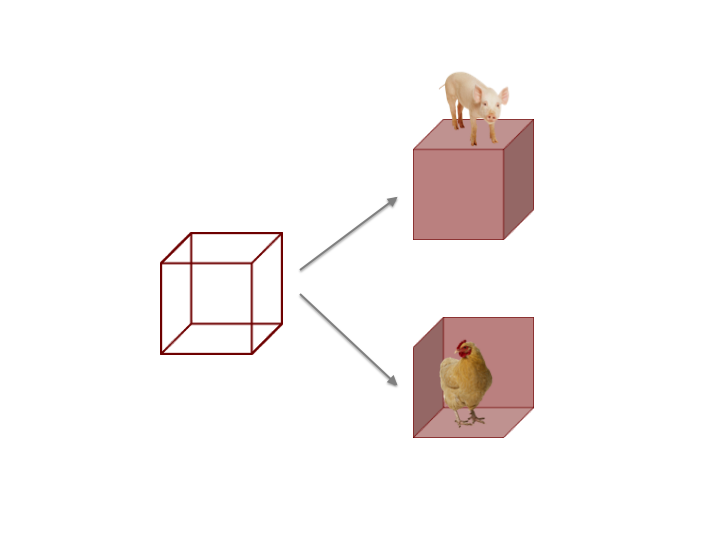
Think of the quantum state as a wireframe cube, that is, a simple drawing of a cube in paper, like the cube on the left side of the image.

The cube on the right is a 2D representation of a 3D object. Our brain can interpret it in different ways, incompatible with each other.
The cube on the left is a 2D representation of a 3D object. Our brain can interpret it in different ways, incompatible with each other, as shown in the right side of the diagram.

The cube on the left side is not really a cube at all! It is just a 2D representation of a 3D object. However, our brain likes to interpret it as a 3D object, a real thing. The drawings on the right serve as suggestions of possible ways our brain could interpret the 2D image. For example, we could imagine it as a box, I decided to put a little pig on top of it. You can see how a box like is perfectly consistent with the 2D image on the left. Likewise, the 2D image could be seen as a corner, like the corner of a room. I used a chicken to help you visualize this interpretation, that is also consistent with the 2D image.

However, altough the diagram with the pig and the one with the chicken are both compatible with the 2D wireframe, they are incompatible with each other! Your brain can visualize the 2D wireframe as a Box, or as a Corner, maybe even switch between both visualizations, but not have them both at the same time.

The analogy is complete now. The 2D image is the quantum states, in a sense it can be said to contain many choices of 3D visualizations within it. A quantum measurement is then analogous to the limitations our brain demand of the image following the laws of perspective. Only one interpretation at a time is allowed by the brain, just like the quantum state can show only one physical property of the two incompatible physical properties at a time.

The analogy breaks in several ways, I’ll point one. Although our brain has some control of the 3D image it decides to see out of the 2D object, there is no such control in quantum superposition. The measured physical property that is seen is chosen at random from the incompatible options. Quantum superposition does not in any way mean that our brain gets to chose what physical reality is, but it does stresses the fundamental probabilistic nature of reality.

Remember, superposition means that two incompatible properties can exist simultaneously, without any inconsistency.

===

If you try to fail and succeed, which one have you done?

Outreach: Back to La Iupi

I just came back from Puerto Rico, into the Bostonian winter.

Although I had a very brief opportunity to see my people back home, the main purpose of the trip was work. Several young professors from the Chemistry and Chemical Biology department at Harvard have started an effort to outreach, but for real. The main purpose of the program is to visit universities with a big population of under-represented minorities. I proposed to go to Universidad de Puerto Rico, Rio Piedras. I still have many friends there, and it was very good to see again so many professors that gave me many opportunities as an undergrad to grow as a researcher. Without their support, I wouldn’t be a physicist now.

The outreach activity was very successful. The people at the Resource Center for Science and Engineering did an amazing job of coordinating the activity. We were able to talk to many researchers there, and spent a good day with many talented science undergraduate students from all around the island. I’m sure new collaborations will grow from this.

To see information about many undergraduate research programs and how to apply, click here.

To read about graduate school at Harvard, click here.

To see pictures of the event, click here.

Quantum rules Photosynthesis

My main research project was featured in Discover magazine! The cover has some abstract flowery-looking explosion that represents quantum mechanics.

My work in the Aspuru-Guzik group focuses on the quantum aspects of excitonic transfer as applied to photosynthetic complexes and solar harvesting devices. The mistitled article can be found here:

Is quantum mechanics controlling your brain?

Then came the revelation: Instead of haphazardly moving from one connective channel to the next, as might be seen in classical physics, energy traveled in several directions at the same time. The researchers theorized that only when the energy had reached the end of the series of connections could an efficient pathway retroactively be found. At that point, the quantum process collapsed, and the electrons’ energy followed that single, most effective path. […]

Elated by the finding, researchers are looking to mimic nature’s quantum ability to build solar energy collectors that work with near-photosynthetic efficiency. Alán Aspuru-Guzik, an assistant professor of chemistry and chemical biology at Harvard University, heads a team that is researching ways to incorporate the quantum lessons of photosynthesis into organic photovoltaic solar cells. This research is in only the earliest stages, but Aspuru-Guzik believes that Fleming’s work will be applicable in the race to manufacture cheap, efficient solar power cells out of organic molecules.

Unfortunately, the pretty good article about quantum effects in photosynthesis is ruined by its title, title that refers only to the final section of the article containing some wild speculations on quantum mechanics and consciousness. Please, don’t take that last part seriously. Although there is strong experimental evidence supporting the role of quantum effects in photosystems, there isn’t anything that suggests a connection between quantum mechanics and consciousness.

Donate computing time for the environment

There is the environmental need and the political will to take solar energy seriously. Our group at Harvard is leading several theoretical and computational efforts to develop more efficient solar panels. One of our efforts (not my project) is to use computational chemistry tools to find novel materials that would lead to better solar technologies. This is mostly performed by trial and error. A lot of it.

A certain molecular arrangement is “proposed” randomly, and the computer calculates its molecular energy to see if it makes sense (if it is a realistic material) and then if it is useful for solar panels. This trial and error approach takes a long time, requires a lot of computational power, but it can be parallelized in a straight-forward manner.

How can you help us?

By downloading the Harvard Clean Energy Project software. With it, you can donate your unused computer cycles, when the computer is on but not using the processor much, to help perform the combinatorial calculations. With these small computing contributions from thousands of students it is expected that the calculations will be done ten times faster than in a supercomputer.

Right now it is only available for Windows, but in the next few weeks it should be compatible with Linux and Mac too.

The project has had a lot of visibility, the other day BBC called our office!

Check out all the news articles written about it.

The fixed point of the cow within the cow… and time travel.

Consider a matryoska, russian dolls that you open up and have another doll that you open up, etc etc.

A matryoshka is a doll with a matryoshka inside.

Now, imagine this could go on forever, an infinite recursion of a doll within a doll within a doll…

This couldn’t happen in real life, after all, there will be a point that the doll will be made of so few atoms that it wouldn’t look like a doll anymore. In fact, this is sort of the idea that motivated Democritus, the greek philosopher from around 400BC, to propose the concept of atoms, atoms providing an end to the philosophical difficulties of making things smaller and smaller. But, time has passed, Democritus died, Newton was born, solved the mathematical difficulties of these kind of arguments, and then died too, and luckly now we feel empowered and gutsy enough to think about a doll within a doll within a doll within a doll… even if in real life this wouldn’t be possible.

In your minds eye imagine that point that is common to the center of all dolls, yes, all infinite number of them.  This point is called the fixed point.

A simpler, more visual example might be of help. Look at the label of a chocolate box, where a nun carries a tray with a chocolate box whose label has a nun that carries a tray…

A nun with a funky hat.

All those chocolate boxes within chocolate boxes have one point in common. If you where going to imagine the point where the next chocolate box will come from, that would be the common point, the fixed point.

The fixed point is a property of maps, a mathematical transformation, that converts something into a something within itself. Maps are very general kinds of transformations.

Mathematically, an object in the original “Something” (the domain) could be called $$X$$. The transformation $$M$$ would take $$X$$ to $$Y$$, which is also inside the “Something”. These are all related by: $$X rightarrow Y=Mleft(Xright)$$.

Any map that takes you inside of yourself has a fixed point.

The oval on the left gets mapped into another oval in the right, that is smaller and within the space occupied by the original oval. The red arrows indicate how a point at the top (bottom) of the oval gets mapped to another oval.

A fixed point would be a point $$F$$ such that $$F=Mleft(Fright)$$, that is, after the mapping nothing happens to it. In the diagram this is illustrated by the green arrow.

If you where going to map using $$M$$ the small oval on the right, $$Y$$, to another oval, $$Z$$, just like $$Y$$ was inside $$X$$, the oval $$Z$$ would be inside $$Y$$. Repeating this until you get sick of this (or reach infinity) would show that the fixed point $$F$$ is common to every single one of those ovals. There is a mathematical theorem that says that if a map maps something into itself, it will always have at least one fixed point.

Let me say that again to summarize: Maps have at least one fixed point.

One of my favorite applications of maps and fixed points is time travel. Imagine a person, let’s call him McFly. McFly’s person, life, memories, history, everything that he is and has been, will be labeled by $$X$$. McFly is friends with a mad scientist who gives him a time machine $$M$$.

Your friendly neighborhood mad scientist next to your average time traveller.
Your friendly neighborhood mad scientist next to your average time traveler.

With it, McFly can travel back in time, and change his own history, becoming a new self $$Y=Mleft(Xright)$$. He can for example go back in time, deposit a penny in a bank account, wait for many years collecting interests, take the money out in the present and become rich. The new McFly, $$Y$$, is now rich. McFly could also go back in time, prevent his parents from ever meeting, and he never been born. The new McFly $$Y$$ doesn’t even exists.

These paradoxes are what make imagining time travel so much fun. The problem is that it also makes it seem implausible, violations of cause and effect being most unphysical. Except for one kind of solution called closed-timelike curves.

Closed-timelike curves would be like traveling back in time but not affecting the future at all, therefore, not violating causality. Closed-timelike curves is time travel that is consistent with itself. For example, a closed-timelike curve would be that McFly travels back in time to deposit the money in the bank whose collected interests will allow the mad scientist to build the time travel machine that will allow McFly to travel back in time to deposit the money… etc etc.

A closed-timelike curve is a fixed point $$F$$ in time travel $$M$$, such that $$F=Mleft( F right)$$.

A closed-timelike curve would not be one when McFly changes history in such a way he is unable to travel back in time to change history. For example, if McFly lost the penny he woudn’t be able to deposit it in the bank and thus the mad scientist won’t have any money to build the time machine creating a paradox.

The theorem that there must be a fixed point in any map implies that there will also be closed-timelike curves. Time travel in one of those wouldn’t violate causality, but might not be to useful either.

I leave you with a picture of a MinusTwoFish-approved cheese brand.

The cow within the cow within the cow within the cow...
The cow within the cow within the cow within the cow…

Also, a very cool video of the effect of self maps and fixed points. Click it!
Flash Video of Droste Effect

===

“A witty saying proves nothing.” –Voltaire
Imagine a molecule. Now Imagine a quantum computer solving it.

A quantum circuit, a molecular spectra, a molecule: will they ever have a threesome?

So, we have the periodic table. We know that atoms combine into molecules depending on their energy spectrum, its energy levels. We know quantum physics, the theory that reigns in the atomic regime.We know math. We know quite a lot, actually.

So, we want to create new chemicals. Having new materials would give us new technologies, having new molecules would provide us with new medicines, saving millions of lives.

How come it is so hard to use what we know to get what we want?

The problem is that atoms have many electrons, and you have to calculate the equations for each electron. But, electrons interact with other, the solution of the equations of one depend on the solutions of the equations of the other. The solutions are interconnected, coupled. This is know as the many body problem. This makes solving the equations very hard.

Although we know what to do to calculate the energy of a complicated molecule, we can’t actually do it. It takes too long, even for a computer. Computers get faster every year, but they don’t get fast fast enough for the problem. Making the molecule just a bit more complicated demands us to have a computer much much much more powerful than for one a bit simpler. In other words, the problem of solving the energy of a molecule doesn’t “scale” well.

Enter quantum computers.

Unlike a conventional computer, Aspuru-Guzik and his colleagues say, a quantum computer could complete the steps necessary to simulate a chemical reaction in a time that doesn’t increase exponentially with the reaction’s complexity.

What is a quantum computer? How is it different from other computers? What tricks can it do to solve chemical reactions faster than a normal computer?

This blog is about those questions and more. Stay tuned.