Time-dependent current-density functional theory for generalized open quantum system
Joel Yuen-Zhou, César Rodríguez-Rosario and Alán Aspuru-Guzik
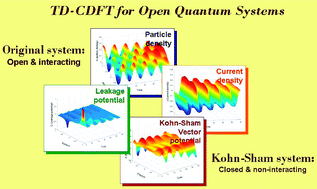
In this article, we prove the one-to-one correspondence between vector potentials and particle and current densities in the context of master equations with arbitrary memory kernels, therefore extending time-dependent current-density functional theory (TD-CDFT) to the domain of generalized many-body open quantum systems (OQS). We also analyse the issue of A-representability for the Kohn–Sham (KS) scheme proposed by DAgosta and Di Ventra for Markovian OQS [Phys. Rev. Lett. 2007, 98, 226403] and discuss its domain of validity. We suggest ways to expand their scheme, but also propose a novel KS scheme where the auxiliary system is both closed and non-interacting. This scheme is tested numerically with a model system, and several considerations for the future development of functionals are indicated. Our results formalize the possibility of practising TD-CDFT in OQS, hence expanding the applicability of the theory to non-Hamiltonian evolutions.
The Research Laboratory of Electronics (RLE) at the Massachusetts Institute of Technology (MIT) will be home to one of 46 new multi-million-dollar Energy Frontier Research Centers (EFRCs) announced today by the White House in conjunction with a speech delivered by President Barack Obama at the annual meeting of the National Academy of Sciences. The EFRCs, which will pursue advanced scientific research on energy, are being established by the U.S. Department of Energy Office of Science at universities, national laboratories, nonprofit organizations, and private firms across the nation.
[…]
The new Center for Excitonics will be a comprehensive center on the science and applications of excitons. It will be based in RLE but include researchers throughout MIT, as well as Harvard University and Brookhaven National Laboratory.
Excitons are the crucial intermediate for energy transduction in low cost, disordered semiconductors. The Center’s researchers will tackle the following questions: How are excitons created and destroyed? How can we control the migration of excitons? How do they move through interfaces and around defects? How can we control the transition between coherence and incoherence, or localization and delocalization? And finally, how can we build excitonic devices that address society’s needs for a new generation of energy technologies? Potential technological outcomes from the Center’s activities include the development of efficient synthetic and room-temperature-reconfigurable light absorbing antennas with sub-5-nm feature sizes for solar cells; stable organic light emitting devices exploiting spin orbit coupling to achieve internal fluorescent efficiencies approaching 100%, and novel nanowire, nanowire heterostructure and nanowire-quantum dot aggregate materials for solid state lighting; and thin film, non-tracking solar concentrators with power efficiencies exceeding 30%.
These are very excitonic exciting news for us. We worked very hard in the proposal, and pushing a shadow Excitonic Center, waiting to see if the real center will be approved. The Excitonics Seminar series has been fantastic so far, with the best speakers in the field. We have very high expectations that the breakthroughs that will come out of our center will lead to more efficient solar energy technologies.
—
I guess somebody up there likes me.
-The Sirens of Titan
Most probably you have seen that famous Solvay Conference Picture, the one with Einstein, Dirac, M. Curie, Schrodinger, Heisenberg, and many other famous physicists.
The famous Solvay Conference picture.
We decided to take a group picture in the courtyard of our building in Harvard imitating that picture.
Group Picture Imitating the Solvay Conference
===
“If I understand Dirac correctly, his meaning is this: there is no God, and Dirac is his Prophet.”
-Wolfgang Pauli
After a long, tough, wintery and busy month, I’m back.
Progress report follows.
Alright, first, I went to SQuInT. The Southwestern Quantum Information and Technology conference isn’t true to its name. It was held in the Northwest, Seattle, where beautiful weather seemed to tunnel through the mountains’ potential just for us. The conference itself was very productive and I had the opportunity to see family, friends and collaborators.
In other news, we submitted a paper on Open Quantum Systems and Time Dependent Current Density Functional Theory titled Time-dependent current-density functional theory for generalized open quantum systemsto the journal Physical Chemistry, Chemical Physics (PCCP). It has been accepted for publication and might appear in a special issue on Time Dependent Density Functional Theory.
We also submitted a related paper to another journal, paper titled Time-Dependent Density Functional Theory for Open Quantum Systems using Closed Systems. You can read it in the arXiv.
Finally, I went to the APS March Meeting, where 7,000 physicists took over the city of Pittsburgh, where I was able to find bars decorated with Roberto Clemente posters, where a restaurant served Carrucho (Conch). Sometimes I feel the APS March meeting is too big, too overwhelming, talks are too short, and there is too much going on simultaneously. But then I’m surprised by meeting people I hadn’t seen in almost 10 years now, and by how APS March meeting always lead to new collaborations.
Exciting times these are.
—
“I have wept three times in my life. Once when my first opera failed. Once again, the first time I heard Paganini play the violin. And once when a truffled turkey fell overboard at a boating picnic.”
-Gioachino Rossini
As I mentioned before, the Clean Energy Project is a way for people like you to donate your unused computer time to help us perform complex chemical calculations. These calculations will predict properties of new materials that might be used towards new solar energy panels. It was released for Windows, and quickly become popular in the international press.
Stephen Quake is a Bioengineer from Stanford that studies microfluidics, or how to make devices-on-a-chip that can perform many biological tests at once.
Cool stuff.
He also published a column on the NY Times discussing his insights into the personal economic pressures that a researcher confronts. A very interesting read of you ever asked “Where do those scientitians get their money? How do they spend it?”
Where does the money come from to pay for our science? Mostly from the federal government — your tax dollars at work — and non-profit foundations. […]
When a university hires a professor, they typically agree to provide a start-up package to support that professor’s research over the first few years, after which the professor must seek external funding. This funding is needed to buy research supplies, pay stipends and tuition for graduate students, and even to support the salary of the faculty member. In fact, the university rarely pays the full salary of the professor — depending on the department, the professor must find between 25 percent and 75 percent of his or her salary from outside grants.[…]
If they can’t raise grants to support their research every year, they won’t get paid. So not only do they have to worry about publish or perish, it’s also funding or famine, in the very real sense that without a grant there might not be food on the family dinner table!
It is a dog-eats-dog world, where, unfortunately, the science can’t be the top priority.
As I said before, Harvard lost a lot of money, $8Billions, to be exact. Hiring is frozen everywhere, impacting postdocs whose contracts are year-to-year. I’m optimistic that the grants we have written will get funded; I like it here, except the horrible weather, and don’t want to leave yet.
Harvard University said today that it’s cutting about a quarter of the staff — or about 50 jobs — from the company that manages its endowment after the fund tumbled $8 billion in four months.
The estimated 22 percent decline, by far the largest in higher education, was the sharpest drop in the endowment’s history. The fund was valued June 30 at $36.9 billion before falling to $28.7 billion by October.
The university is projecting the endowment will decline by a total of 30 percent by the end of the fiscal year in June.
Quantum superposition is one of the most difficult concepts to understand in all physics. It lies at the heart of what makes quantum mechanics so counter intuitive. I find myself always saying things like “It is in both states at the same time, until you look at it, and then it is only one thing.”, which sounds like pure hocus-pocus. It is not. I plan to have a mathematical description of quantum superposition, but decided for now to start with a simple analogy.
A quantum state is a mathematical representation of a physical property. The act of determining the physical property is called a measurement, that is, “looking” at the state to determine what it is. Quantum mechanics allows for a simple mathematical way to describe both the state, and the outcome of the measurement. The price for this mathematical simplicity is a conceptual inconsistency in the physical description of the object.
Thus, the quantum state can have two incompatible physical properties simultaneously, while when the state is actually measured, only one of them physical properties is measured, either one, it is determined by chance. Now, the analogy.
I cannot stress enough how this is an analogy, a mnemonic device if you will. This is not the full story of what quantum superposition is, just something to wet your appetite.
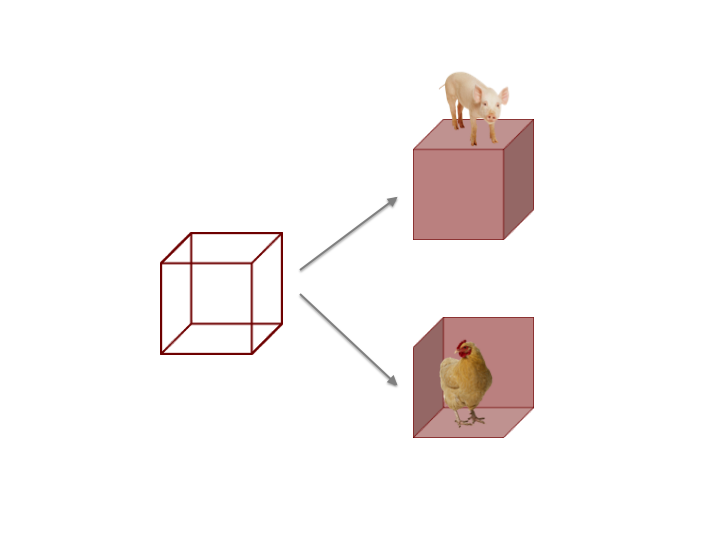
Think of the quantum state as a wireframe cube, that is, a simple drawing of a cube in paper, like the cube on the left side of the image.
The cube on the left is a 2D representation of a 3D object. Our brain can interpret it in different ways, incompatible with each other, as shown in the right side of the diagram.
The cube on the left side is not really a cube at all! It is just a 2D representation of a 3D object. However, our brain likes to interpret it as a 3D object, a real thing. The drawings on the right serve as suggestions of possible ways our brain could interpret the 2D image. For example, we could imagine it as a box, I decided to put a little pig on top of it. You can see how a box like is perfectly consistent with the 2D image on the left. Likewise, the 2D image could be seen as a corner, like the corner of a room. I used a chicken to help you visualize this interpretation, that is also consistent with the 2D image.
However, altough the diagram with the pig and the one with the chicken are both compatible with the 2D wireframe, they are incompatible with each other! Your brain can visualize the 2D wireframe as a Box, or as a Corner, maybe even switch between both visualizations, but not have them both at the same time.
The analogy is complete now. The 2D image is the quantum states, in a sense it can be said to contain many choices of 3D visualizations within it. A quantum measurement is then analogous to the limitations our brain demand of the image following the laws of perspective. Only one interpretation at a time is allowed by the brain, just like the quantum state can show only one physical property of the two incompatible physical properties at a time.
The analogy breaks in several ways, I’ll point one. Although our brain has some control of the 3D image it decides to see out of the 2D object, there is no such control in quantum superposition. The measured physical property that is seen is chosen at random from the incompatible options. Quantum superposition does not in any way mean that our brain gets to chose what physical reality is, but it does stresses the fundamental probabilistic nature of reality.
Remember, superposition means that two incompatible properties can exist simultaneously, without any inconsistency.
===
If you try to fail and succeed, which one have you done?
I just came back from Puerto Rico, into the Bostonian winter.
Although I had a very brief opportunity to see my people back home, the main purpose of the trip was work. Several young professors from the Chemistry and Chemical Biology department at Harvard have started an effort to outreach, but for real. The main purpose of the program is to visit universities with a big population of under-represented minorities. I proposed to go to Universidad de Puerto Rico, Rio Piedras. I still have many friends there, and it was very good to see again so many professors that gave me many opportunities as an undergrad to grow as a researcher. Without their support, I wouldn’t be a physicist now.
The outreach activity was very successful. The people at the Resource Center for Science and Engineering did an amazing job of coordinating the activity. We were able to talk to many researchers there, and spent a good day with many talented science undergraduate students from all around the island. I’m sure new collaborations will grow from this.
The cover of the Discover issue that discusses the work at my lab.
This is a follow up to the post about the Discover magazine article that discusses our group’s research studying quantum effects in photosynthesis. The issue (February) is out in stores now. I never liked Discover magazine much, but this time I had to purchase it.
Agosta and Di Ventra for Markovian OQS [Phys. Rev. Lett. 2007, 98, 226403] and discuss its domain of validity. We suggest ways to expand their scheme, but also propose a novel KS scheme where the auxiliary system is both closed and non-interacting. This scheme is tested numerically with a model system, and several considerations for the future development of functionals are indicated. Our results formalize the possibility of practising TD-CDFT in OQS, hence expanding the applicability of the theory to non-Hamiltonian evolutions.




 Minus Two Fish