It’s the end of the transistor as we know it

We take the constant rate of increase in computing power for granted. One of the founders of Intel, Moore, estimated once the rate of the number of transistors $$n$$ in an integrated chip to be exponential, doubling every year. The smaller size of these transistors allows manufactures to pack more and more in each chip every year, making processors more powerful, memory capacities larger, and overall, computers faster.

Moore’s law can be stated as: $$n(t)=2^{frac{t-t_0}{2}}$$ where $$n(t)$$ is the number of transistors on a chip at some time in the future $$t$$, $$n(t_0)$$ is the known number of transistors for a time $$t_0$$.

This exponential trend cannot be sustained forever, at some point the transistor will be so small that quantum effects will dominate and the laws of physics that make the transistor work will change dramatically, effectively making them stop working. J. Powel looked at this in The Quantum Limit to Moore’s Law (subscrition required). Here, I reproduce a similar calculation with compatible results.

The question I am interested in is: given all things equal, what is a good estimate for the year that we will reach the quantum regime where transistors won’t be able to get any smaller?

First, we need one data point of the number of transistors in an integrated circuit at a certain year. For this, I used Intel’s own data that says that in 2007 they could manufacture transistor of lenght $$45nm=45times10^{-9}m$$. By assuming that the number of transistors is inversely proportional to the size of the transistor, we can estimate $$n(t_0)$$.

Now, we need to estimate the number of transistors in an integrated circuit just before they transistor reaches the quantum limit. For this, I chose the transistor to be of the order of the Compton wavelength of the electron, or 10^{-12} m . The Compton wavelength $$lambda=frac{h}{m_e c}$$ is the dimension of an electron from Heisenberg’s uncertainty principle. If you are in this regime, the electron behaves mostly as a wave, not as a particle and the electronic properties of the transistor will change, making it unusable. It is a fundamental physical limitation of the size of a transistor.

With this numbers at hand, I solved for $$t$$, and found out the year where Moore’s law will break:

Year $$2038$$ is when Moore’s law will not hold anymore.

The purpose of this excersize is NOT to predict the end of the computer growth as we know it, as this is bound to fail, but to stress the need for understanding electron transport in the quantum regime. The quantum regime is something we will reach in my lifetime, and a new theory of electronics in the fully quantum regime is needed before we get there.

But, also, this number misteriously agrees with XKCD’s end-of-the-world prediction in a manner different from what XKCD intended.
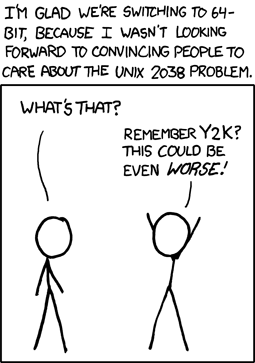
Multiple apocalyptic scenarios point towards 2038.

Creepy.

mobilis in mobili

US Gross Product is 1/3 Quantum, and Chapulines

According to an article in Science, quantum = $$$.

Is Quantum Mechanics Tried, True, Wildly Successful, and Wrong?

[…] Sure, it’s the most powerful and accurate scientific theory ever devised. Yes, its bizarre predictions about the behavior of atoms and all other particles have been confirmed many times over with multi-decimal-place exactitude. True, technologies derived from quantum mechanics may account for 30% of the gross national product of the United States. So what’s not to like? [emphasis mine]

Why would this be? Well, electronics are an essential part of the US economy, and transistors are fundamentally quantum mechanical. This figure doesn’t include any quantum computing private companies.

On that subject, I just witnessed the founder of D:Wave (the first quantum computation private company) eat a taco de chapulines. Yes, that means grasshopper taco.

Tunneling is fun. -Alan

The union that never returned?

The word on the street is “What’s up with the MBTA?”. The Mass. Bay Transport Authority, who runs the extensive and vital public transportation system on the Boston metropolitan area, is on the public eye. MBTA threatened to increase fares, cut down lines, and increased the number of employees and their benefits. Meanwhile, a cellphone ban was enforced (and violated) after an MBTA conductor caused an accident on the Green line while texting his girlfriend. The latest news is that a major restructuring of the system will make a monstrous Department of Transportation that will now oversee the MBTA. It is too early to tell what changes this will bring to the subway system, but the MBTA union feels very threatened. The MBTA drama will continue.

This mess is a perfect excuse to listen to some good music. I was able to track down the history of a song that is very close to Bostonian’s love-hate relationship to their public transportation.

First, the original song “The Ship that Never Return”

narrates how a ship on the east coast lacks the money to pay docking fees, and was unable to return home. This song was later adapted to the more familiar “Charlie on the M.T.A.” song.

Did he ever return,
No he never returned
And his fate is still unlearn’d
He may ride forever
‘neath the streets of Boston
He’s the man who never returned.

Charlie, the man who, according to the 1948 song, didn’t have enough money to pay the exit fare and was unable to leave the subway system (then called the M.T.A).

“This could happen to YOU” [banjo]

The exit-fare system was abolished after the introduction of the CharlieCard on 2006, card system named as a tribute to the song.

And of course, this song inspired a modern version by Boston’s own Dropkick Murphys titled “Skinhead on the MBTA”.

Stupidity and Research

A friend recommended this short essay that resonates with my own philosophy of scientific research.

The importance of stupidity in scientific research [PDF]

One of the beautiful things about science is that it allows us to bumble along, getting it wrong time after time, and feel perfectly fine as long as we learn something each time.

If we knew what it was we were doing, it would not be called research, would it?- Albert Einstein

Werner and Paul Adrien Maurice on a Steamer

Is this the interaction picture?

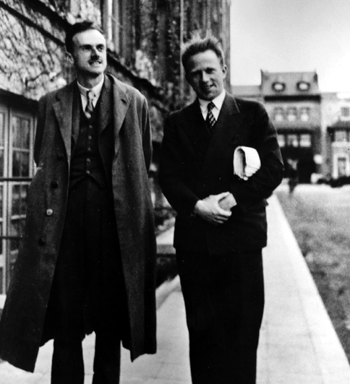
W. Heisenberg and P.A.M. Dirac, two of the founders quantum mechanics, were on a steamer boat from America to Japan. Heisenberg, a social butterfly, would participate of all the social activities, while Dirac, always very shy, would just sit quietly and watch.

“Heisenberg, why do you dance?” Dirac honestly inquires. “Well, when there are nice girls it is a pleasure to dance.” Heisenberg responds. Dirac turns silent for a few minutes, involved in deep thought. He finally questions, “Heisenberg, how do you know beforehand that the girls are nice?”

According to Heisenberg, this is a true story.


Lord, grant me chastity and continence… but not yet.
-St. Augustine

Nobel Prize vs. NBA

Heard on the streets of Cambridge.

In 2004, Richard Axel won the Nobel Prize in Medicine for the “discoveries of odorant receptors and the organization of the olfactory system”.

Richard Axel, Nobel Laurate Richard Axel, Nobel Laurate

As a teenager in NYC, he attended Stuyvesant High School, one of the most competitive public schools in the nation, an institution that focuses on math and science excellence. His height made him a key player of his high school’s basketball team.

Axel recalls his most memorable experience as part of the team; it was when he faced on the court Ferdinand Lewis Alcindor, the other team’s center. Ferdinand Lewis Alcindor would later change his name to Kareem Abdul-Jabbar, the highest scoring player in NBA history.

Kareem Abdul-Jabbar, the only man to face a Nobel Laureates and Bruce Lee Kareem Abdul-Jabbar, the only man to face a Nobel Laureates and Bruce Lee

Axel has the ball, and tries to pass Alcindor’s defense on the left. Alcindor stops him. Axel goes to the right, Alcindor stops him again. Face to face, Abdul-Jabbar says to Axel:

“So, which way are you going to go now, Einstein?”

After intimidating the Nobel Laureate, Kareem proceeded to score about 50 points in that game.

Nobel Prize vs. NBA? NBA wins.


“Any sufficiantly advanced technology is indistinguishable from a yo-yo.” -Enoch Root

Wetting and Spreading

Alright, I found it, the best title ever on a published paper. And it was published in Review of Modern Physics, a journal with an impact factor of 38, not any random journal.

Wetting and spreading

Daniel Bonn, Jens Eggers, Joseph Indekeu, Jacques Meunier and Etienne Rolley

Wetting phenomena are ubiquitous in nature and technology. A solid substrate exposed to the environment is almost invariably covered by a layer of fluid material. In this review, the surface forces that lead to wetting are considered, and the equilibrium surface coverage of a substrate in contact with a drop of liquid. Depending on the nature of the surface forces involved, different scenarios for wetting phase transitions are possible; recent progress allows us to relate the critical exponents directly to the nature of the surface forces which lead to the different wetting scenarios. Thermal fluctuation effects, which can be greatly enhanced for wetting of geometrically or chemically structured substrates, and are much stronger in colloidal suspensions, modify the adsorption singularities. Macroscopic descriptions and microscopic theories have been developed to understand and predict wetting behavior relevant to microfluidics and nanofluidics applications. Then the dynamics of wetting is examined. A drop, placed on a substrate which it wets, spreads out to form a film. Conversely, a nonwetted substrate previously covered by a film dewets upon an appropriate change of system parameters. The hydrodynamics of both wetting and dewetting is influenced by the presence of the three-phase contact line separating “wet” regions from those that are either dry or covered by a microscopic film only. Recent theoretical, experimental, and numerical progress in the description of moving contact line dynamics are reviewed, and its relation to the thermodynamics of wetting is explored. In addition, recent progress on rough surfaces is surveyed. The anchoring of contact lines and contact angle hysteresis are explored resulting from surface inhomogeneities. Further, new ways to mold wetting characteristics according to technological constraints are discussed, for example, the use of patterned surfaces, surfactants, or complex fluids.

Most of us live hoping we will get a paper published with a title this cool.

Quantum Stochastic Walks

We just posted a paper in the arXiv.

Quantum stochastic walks: A generalization of classical random walks and quantum walks

We introduce the quantum stochastic walk (QSW), which determines the evolution of generalized quantum mechanical walk on a graph that obeys a quantum stochastic equation of motion. Using an axiomatic approach, we specify the rules for all possible quantum, classical and quantum-stochastic transitions of a vertex as defined from its connectivity. We show how the family of possible QSW encompasses both the classical random walk (CRW) and the quantum walks (QW) as special cases, but also includes more general probability distributions. As an example, we study the QSW on the line, its QW to CRW transition and transitions to genearlized QSWs that go beyond the CRW and QW. QSWs provide a new framework to the study of quantum walks with environmental effects as well as quantum algorithms.

I promise a simple explanation of Classical Random Walks soon!

What is Time-Dependent Density Functional Theory?

Time-Dependent Density Functional Theory looked like a mess when it was first explained to me. I probably made the face of a person who smells sushi for their first time, wondering if this is some sort of bad joke.

After all, quantum mechanics is supposed to be a theory of non-commuting observables that evolve in a linear fashion. TD-DFT is nothing like that, yet it claims to reproduce all the same effects. Fishy indeed.

TD-DFT first focuses on the density of the wave function, in particular, the position basis of it. This is relevant for chemical calculations where it is very important to know where are the electrons. Of course, the density is one of many observables that are relevant, but TD-DFT makes it stand out by letting this observable evolve by means of a functional of itself. In other words, you don’t fully evolve the wave function by means of an operator, but instead you have a very complicated, non-linear functional that takes as its input the density and lets it evolve. In practice, since the functional is non-linear, in practice, the evolution is done iteratively.

Runge and Gross proved that if you only cared about the evolution of one observable, the density, this procedure is equivalent to the full quantum mechanical evolution. In other words, you can map the evolution of a particular observable the wavefunction under Schrodinger’s equation into a functional of the same observable.

What you gain from this approach is a computational speedup. The prize paid is that writing the exact functional is actually a very hard problem, at least as hard as doing the full quantum mechanical evolution. However, in practice, approximated functional can be written down and used for real calculations that can predict properties for real materials. This technique is widely used, mostly as a black box toolkit used by many physical chemists around the world.

In our latest papers, we were able to show that this mapping can be also performed for open quantum systems instead of just Schrodinger’s equation. First, we developed the general theory of how the Runge-Gross theorem can be generalized, placing it in context of previous incomplete attempts. This paper was published in PCCP as a Hot Article. In it, we discuss how the theorem works even in the highly non-Markovian regime of an open quantum system.

In our second paper, we take this even further. The evolution of an observable of an open quantum system can be mapped to a functional for a close system. At first, this seemed counter-intuitive. After all, you cannot map the evolution of an open system into a closed system.

O te peinas o te haces rolos.

However, if you only care about one observable, and you are willing to use non-linear functionals, this can be done consistently, for just that observable. Since most of the code written for TD-DFT was for closed systems, our results shows that those techniques could be used to model open quantum systems. We feel that new chemical calculations with thermodynamic effects can now be explored with this theory.


Dr. Strangelove: It is not only possible, it is essential.