I just came back from Puerto Rico, into the Bostonian winter.
Although I had a very brief opportunity to see my people back home, the main purpose of the trip was work. Several young professors from the Chemistry and Chemical Biology department at Harvard have started an effort to outreach, but for real. The main purpose of the program is to visit universities with a big population of under-represented minorities. I proposed to go to Universidad de Puerto Rico, Rio Piedras. I still have many friends there, and it was very good to see again so many professors that gave me many opportunities as an undergrad to grow as a researcher. Without their support, I wouldn’t be a physicist now.
The outreach activity was very successful. The people at the Resource Center for Science and Engineering did an amazing job of coordinating the activity. We were able to talk to many researchers there, and spent a good day with many talented science undergraduate students from all around the island. I’m sure new collaborations will grow from this.
The cover of the Discover issue that discusses the work at my lab.
This is a follow up to the post about the Discover magazine article that discusses our group’s research studying quantum effects in photosynthesis. The issue (February) is out in stores now. I never liked Discover magazine much, but this time I had to purchase it.
My main research project was featured in Discover magazine! The cover has some abstract flowery-looking explosion that represents quantum mechanics.
My work in the Aspuru-Guzik group focuses on the quantum aspects of excitonic transfer as applied to photosynthetic complexes and solar harvesting devices. The mistitled article can be found here:
Then came the revelation: Instead of haphazardly moving from one connective channel to the next, as might be seen in classical physics, energy traveled in several directions at the same time. The researchers theorized that only when the energy had reached the end of the series of connections could an efficient pathway retroactively be found. At that point, the quantum process collapsed, and the electrons’ energy followed that single, most effective path. […]
Elated by the finding, researchers are looking to mimic nature’s quantum ability to build solar energy collectors that work with near-photosynthetic efficiency. Alán Aspuru-Guzik, an assistant professor of chemistry and chemical biology at Harvard University, heads a team that is researching ways to incorporate the quantum lessons of photosynthesis into organic photovoltaic solar cells. This research is in only the earliest stages, but Aspuru-Guzik believes that Fleming’s work will be applicable in the race to manufacture cheap, efficient solar power cells out of organic molecules.
Unfortunately, the pretty good article about quantum effects in photosynthesis is ruined by its title, title that refers only to the final section of the article containing some wild speculations on quantum mechanics and consciousness. Please, don’t take that last part seriously. Although there is strong experimental evidence supporting the role of quantum effects in photosystems, there isn’t anything that suggests a connection between quantum mechanics and consciousness.
Life on Earth depends on extracting energy from the solar radiation that reaches the planet, or eating stuff that does it. Professor Sun is the main source of energy required for us to live. Professor Sun generates energy by transforming Hydrogen into Helium by means of nuclear fusion, a process that excretes energy in the form of light that in turn reaches our planet after 8 minutes.
How much of this energy is being used by life on the planet? The question is a complex one, but I decided to do some back of the envelope calculations to the order of magnitude of the light that could be used in principle, is used in practice, and would be needed for Human consumption.
Energy of the Light that Reaches the Atmosphere (1LRA) per year: 10^25 Jules/year ~ 1LRA/y.
This is the total energy that gets to the planet every year, most of it useless to life.
Energy of the light that could be absorbed by photosynthetic organisms: 10^24 J/y ~ 1LRA/month.
This is the total energy that could in principle be used by living organisms. This calculation accounts for light of frequencies that cannot be used by photosynthetic complexes, and also for light falling on areas on the planet where it couldn’t be used anyway. For example, a lot of the energy that hits the surface of the oceans is reflected. The one transmitted gets scattered and some of it is lost.
In order to get a sense of the scale of these processes, we should compare it to the energy consumption of the human race.
Energy consumption of humans: 10^21 J/y ~ 1LRA/minute.
We humans consume about 1minute of the total solar energy that reaches the planet in a year. This includes not only energy spent on machines, but also the actual food we eat. Remember, those plants that we eat, or that our cows eat, harvest energy from the sun. Plants store their unused energy in the form of carbohydrates.
The energy (think: calories) of all the living things that can harvest energy from the sun gives us of an upper bound of much energy could be extracted from processing them.
Energy stored in the total photosynthetic biomass: 10^21J
This is about the total energy of all photosynthetic organisms. If you kill each bacteria, algae, plant in the world and magically extracted all of its energy in a perfectly efficient manner, it would barely provide the human race with energy for one year. And of course, there would no more plants to replant!
Proposals that suggest extracting energy from the stored carbohydrates, such as ethanol-from-corn, are even worse; only a small fraction of the total biomass of the planet is carbohydrates. In other words, we cannot plant enough to ever extract enough energy to fulfill our current energy needs.
Comparing this number to the amount of fossil fuel highlights how small it is. Of course, how much fossil fuel there is in the planet is not known, much less how much of it can we actually reach. Do not take these numbers too seriously, but think about them to have an idea of the order of magnitude of how much energy there is in photosynthetic organisms represent.
Guesstimated Fossil Fuel Reserves: 10^22J
Guesstimated Total Fossil Fuel in Earth, including the unreachable fuel: 10^23J
The fossil fuel reserves are 10 times more than the total current photosynthetic biomass! This is very suggestive: any source of energy that uses biological systems to directly extract energy from the sun, such as harvesting algae, will not be a major factor in any long term energy solution for the human race.
However, look at that very first number. There is a lot of energy falling into the planet. Harvesting this energy directly, by means of photovoltaic solar panels, is a reasonable strategy.
Imagine welding a cube of resistors, each resistor with the resistance of 1 Ohm. If you measured the resistance between opposite corners, what would it be?
I’ll give you a hint. Well, more of a hint, I’ll suggest some guidelines of how a clever method of how to solve it. Don’t read anymore if you want to figure it out on your own.
SPOILER ALERT
Do not read any further if you don’t want any clues on how to solve the A Cube of Resistors puzzle. Be an Electrical Engineer! Don’t cheat!
Alright, here is the hint. The cube has many planes of symmetry. Exploiting them provides a very elegant solution. I decided to redraw the color to illustrate how many resistors are in similar circumstances.
There is a symmetry of the puzzle. The different colored zones have similar properties.
For example, all the resistors corresponding to the blue lines have a common point, the red one, with the same potential. But, the other end of the blue lines must also have the same potential. Why? Just look further down… there is a symmetry to each line. Follow the path from each blue line to the other end, and you will they look the same. Thus, although technically the blue lines are not in parallel, the symmetry of the cube makes them be in the same potential on both ends so they can be treated as if they were in parallel.
A similar argument works for the 6 resistors corresponding to the black lines; they can all be thought as if they were in the same potential difference between their ends. Also, treat the 3 green lines in the same manner, as if they were parallel resistors.
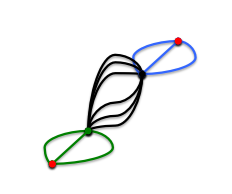
Following this argument, the Cube of Resistors will have the same resistance as the following figure.
This is not a cube. Yet, it has the same resistance and potential changes as the Cube of Resistors.
This figure is obtained by collapsing all the points with the same potential in the cube to one. After all, if the have the same potential, you can short circuit them without changing anything, right?
Now, this problem is much easier to solve. Treat the blues as 3 resistors in parallel, followed in series by 6 in parallel, followed in series by 3 in parallel. Come on, you can do it!
If you want to check your final answer, read ahead. Otherwise, don’t as it will spoil the fun.
BIG SPOILER ALERT
Do not read any further if you don’t want the answer to A Cube of Resistors puzzle.
…
Correct answer to the puzzle coming ahead.
…
Don’t read any further if you don’t want to know the numerical answer.
5/6 of an Ohm
Where does the number come from? Well, the equivalent resistance of the 3 blue lines as if they were in parallel is 1/3 Ohm (three resistance in parallel can carry three times as much current as one of them on its own. By a similar argument, the equivalent resistance of the 6 black lines as if they were in parallel is 1/6 Ohm. The equivalent resistance of the 3 green lines as if they were in parallel is 1/3 Ohm.
Since each color is in series with each other, the resistances add.
1/3 Ohm + 1/6 Ohm + 1/3 Ohm = 5/6 Ohm.
—
“Let’s play this with balalaikas. Give me the biggest balaika! We were open about stuff, we could do that.”
-The Clash


 Minus Two Fish